Executive summary
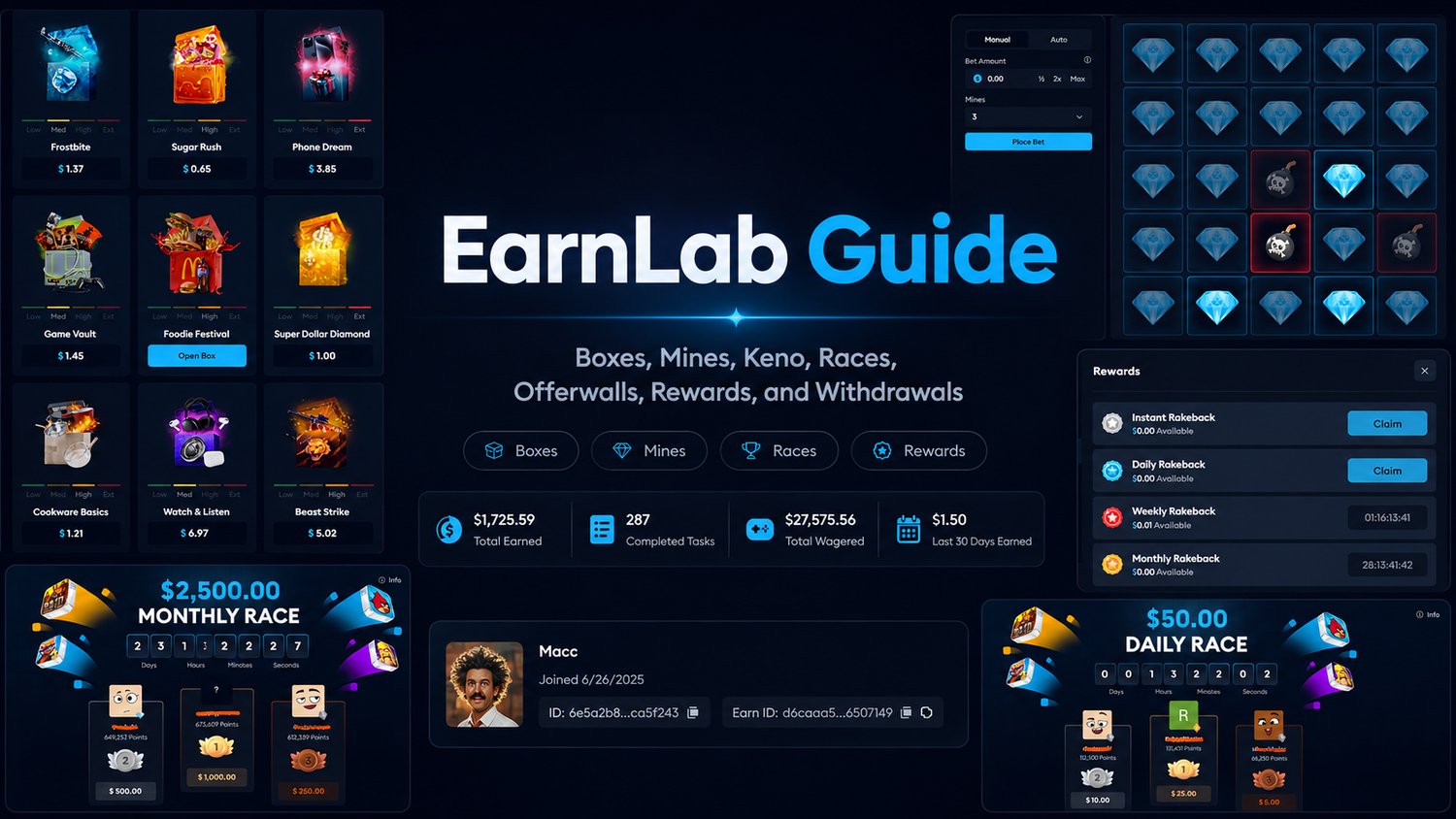
EarnLab is best understood as a hybrid GPT platform plus an internal games layer. On the earning side, it aggregates more than 20 offerwalls and survey providers, and its public site positions the platform around completing surveys, app/game offers, registrations, and similar tasks for Coins. On the gaming side, it offers Boxes, Battles, Keno, and Mines, with separate wallet logic and leaderboard incentives. Public-facing EarnLab pages currently advertise roughly 632,672 users, 3,273,697 tasks completed, and more than $6.68 million paid/earned, while its help center and guide pages emphasize quick onboarding, multiple withdrawal methods, and in-platform races/bonuses.
For a user who wants offers plus original games, the highest-confidence strategy is this: earn first, game second. EarnLab’s own guide says the same offer can differ by $5–$15 across offerwalls on higher-value tasks, and that comparing even two or three walls can materially improve return on time. The same guide also recommends prioritizing offers with at least about $3 of expected value per hour, while the help center makes clear that duplicate attempts, VPN usage, ad blockers, cookie clearing, or switching devices mid-offer can all break tracking or trigger fraud controls. In practice, that means the optimal workflow is to find the best-paying version of an offer, complete it rigorously once, withdraw a baseline amount, and only then allocate a predefined entertainment budget to Boxes, Mines, or Keno.
The dual-wallet system is central. EarnLab’s public FAQ says the Main Balance holds task earnings, while a separate Game Wallet is used for the games section. To withdraw from the Game Wallet, EarnLab says you must either have earned at least 2,500 Coins on your Main Balance or have made a minimum $5 deposit and fully wagered it first. At the same time, the help center says withdrawal methods themselves have their own minimums, including cash at $5, crypto at $0.25, and Gamdom at $0.25, with no EarnLab withdrawal fee but possible cash-provider fees and crypto network fees. The cleanest reading is that EarnLab has an eligibility gate plus per-method minimums, although the public wording is not perfectly explicit.
On the game side, public information is strongest for mechanics and weaker for full live payout tables. EarnLab clearly publishes that Mines uses a 5×5 grid, allows 1–24 mines, and runs at 98% RTP. Keno clearly publishes that users choose 1–10 numbers from 1–40, with 10 numbers drawn, and that a live paytable is visible in the interface; however, the actual current paytables by difficulty are not publicly exposed in the sources reviewed. For Boxes, EarnLab strongly emphasizes provably fair / hash-verifiable outcomes, but the public sources reviewed did not expose current per-box drop rates or box-by-box expected value. That means rigorous strategy is possible for offer selection and for risk budgeting, but not for precise public EV modeling of every live game mode.
Where EarnLab’s public materials do not fully specify a live value—especially box drop rates, current Keno paytables by Easy/Medium/Hard, VIP thresholds, and some details of the AML/KYC page—this report marks the item as unspecified and treats any math beyond the published parameters as an assumption or inference, not as a quoted live rule.
Platform overview and economic model
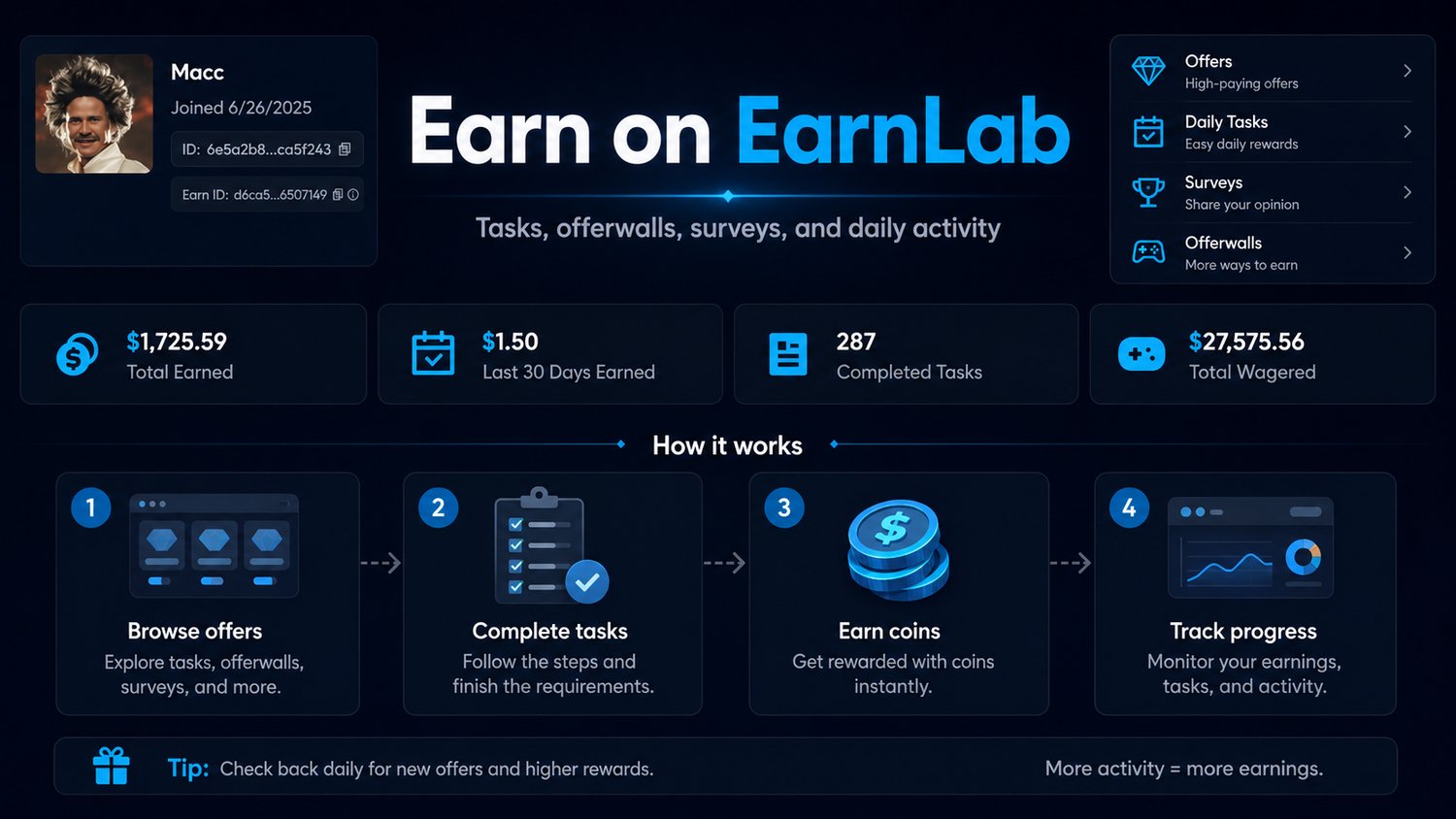
EarnLab’s own homepage describes the product as a hybrid rewards platform that combines traditional task-based earning with interactive games. Public onboarding is simple: the homepage says users can sign up with email, Google, Facebook, or Steam, then use the Earn side for offers/surveys and the Games side for Boxes and Battles. The same page frames the core user journey as Sign Up → Select Task → Withdraw and highlights PayPal, gift cards, and crypto as reward paths.
A concise fact pattern from official public pages looks like this:
| Publicly confirmed item | What the sources say |
|---|---|
| Platform type | Hybrid GPT rewards platform with tasks plus internal games |
| Public scale | 632,672 users; 3,273,697 tasks completed; $6,681,245.03 total earned/paid |
| Earn side | Surveys, apps, offers, mobile games, videos, sign-ups, registrations |
| Games side | Boxes, Battles, Keno, Mines |
| Rewards | PayPal, gift cards, crypto, plus other region/method-specific options |
| Bonuses | VIP program, streak boxes, missions, races/leaderboards, referrals |
These items are all stated or illustrated directly on EarnLab’s official public pages.
The business model is analytically consistent with a publisher-margin GPT platform plus optional gaming monetization. EarnLab’s own guide says it connects to 20+ offerwalls including Torox, AdGem, BitLabs, OfferToro, AdscendMedia, TyrAds, Scrambly, Monlix, AyeT, Lootably, RevU, CPX Research, and PrimeSurveys. Official provider docs from Torox, AdGem, BitLabs, CPX Research, Prime Surveys, TheoremReach, TyrAds, and Adscend Media all describe their products as tools that help apps/websites monetize users through rewarded offers or surveys. That strongly implies the usual GPT economics: advertisers and research buyers fund the tasks, the intermediaries route supply, and the publisher—in this case EarnLab—keeps a margin between gross revenue and user payout.
EarnLab also has an explicit games economy. Its Terms say users may earn Coins, convert Coins into Credits used exclusively for platform games, and may also purchase Credits directly; those purchases are stated to be non-refundable. The Terms also define rakebacks as a portion of Credits used in games that can be paid back to players instantly, daily, weekly, or monthly at EarnLab’s discretion. Separately, the Mines page publishes a 98% RTP / 2% house edge. Taken together, the public sources suggest that sustainability comes from a combination of offerwall/survey margin, credit purchases, and game hold/edge, offset by bonuses, races, and rakeback designed to keep users active.
That model is sustainable only if fraud and chargebacks are controlled. EarnLab’s help center repeatedly refers to provider verification, pending/hold periods, delayed postbacks, risk-based withdrawal review, offerwall-specific rules, and removal of leaderboard points after chargebacks or fraud findings. In other words, generous user-facing rates are supported only so long as advertisers confirm completions and the platform prevents duplicate, VPN, or abusive behavior.
Earning through offers and surveys
Offerwall ecosystem and how to compare it
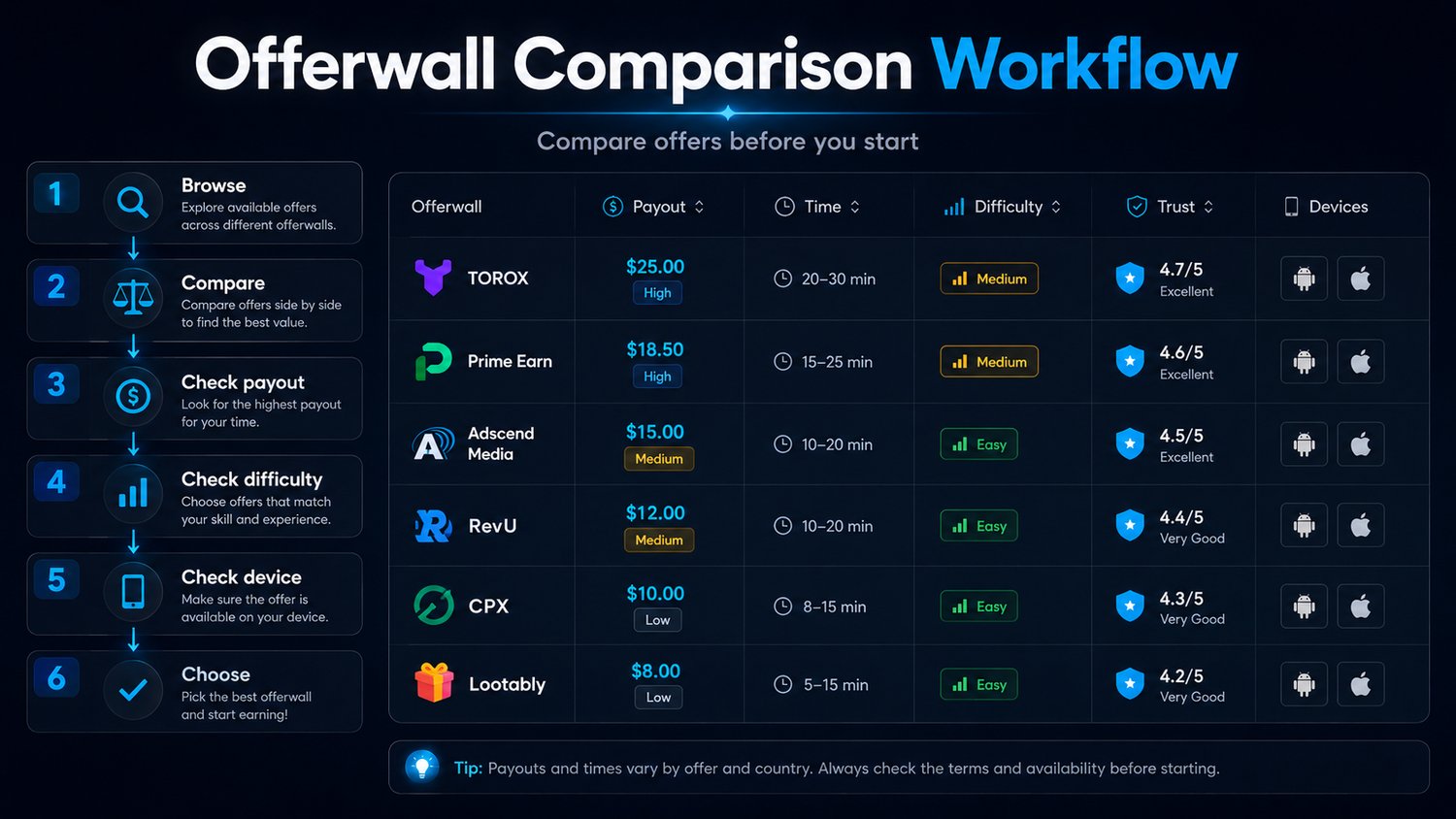
EarnLab’s own guide makes the key economic point: the same offer frequently appears across multiple offerwalls at different payout rates, with differences of $5–$15 on higher-value game tasks, and checking two or three walls first often takes under two minutes. The same guide says Torox tends to be strongest for high-value game offers, while BitLabs and CPX Research are often strong for surveys.
The table below synthesizes EarnLab’s official guide with official provider materials from the major wall/survey vendors that are explicitly visible in public EarnLab sources. Exact rates are inherently live and geo-dependent, so the “payout rate” column is relative guidance, not a fixed contract.
| Provider | Official provider positioning | Typical task emphasis | Practical EarnLab take |
|---|---|---|---|
| Torox | Web/mobile offerwall for apps, games, reward apps | App installs, game milestones, CPA/CPE offers | Best first check for large mobile-game offers, per EarnLab’s guide |
| AdGem | Offer wall + API + multi-reward offers | Milestone offers, app installs, web/mobile actions | Good for laddered/multi-step campaigns |
| BitLabs | Rewarded surveys plus offer inventory | Surveys, some light offers | Strong survey availability on EarnLab |
| CPX Research | Rewarded survey wall with matching algorithms | Surveys | Strong survey availability and matching |
| PrimeSurveys | Survey monetization service | Surveys | Common low-dollar survey completions visible on EarnLab pages |
| TheoremReach | Rewarded surveys and offers, support around the clock, 50+ countries | Surveys first, some additional offers | Useful fallback when other surveywalls reject frequently |
| TyrAds | Offerwall/documentation for mobile and web | App/game offers | Worth checking when game payouts look underpriced elsewhere |
| Adscend Media | Rewarded offerwall and market research monetization | Offers, surveys, app installs | Broad general-purpose backup wall |
A rigorous comparison workflow for users looks like this:
Start with the task or game milestone you want to complete.
Open two or three offerwalls and compare payout, region, device, and hold time.
Use the offer detail page and any available EarnLab guide before starting.
Use the correct device/browser, avoid VPNs, and keep screenshots.
If credit is missing after the wait period, use provider or EarnLab support paths.
That workflow is directly aligned with EarnLab’s own guidance on comparing wall rates, using guides, waiting 72 hours before escalation, and then contacting the provider through offer history or EarnLab’s “Started” task flow.
A practical offerwall comparison sequence is:
- Start with high-value categories first: mobile game milestones, subscription/cashback offers, or high-paying sign-ups, because EarnLab’s guide says this is where the largest payout spreads appear.
- Compare at least two or three walls: Torox first for big game offers; BitLabs/CPX for surveys; then a backup like AdGem, TyrAds, Adscend, or TheoremReach depending on category.
- Check the offer detail page, not just the headline payout: EarnLab says credit time and requirements are shown before you start; a lower nominal payout with faster/safer credit can beat a higher payout with a 30-day hold.
- Read or search for an EarnLab guide if the task is a long mobile game. EarnLab explicitly maintains guides for many high-paying offers and says they include steps, timelines, and pitfalls.
- Commit once. EarnLab’s help center is explicit that completing the “same” offer again on another wall, device, subscription tier, or variation can still count as a duplicate and may lead to chargebacks or flags.
Tracking, hold periods, and offer hygiene
EarnLab’s public support materials give unusually clear tracking hygiene rules. Recommended browsers are Chrome, Firefox, Edge, and Safari, updated to the latest version. Desktop/laptop is generally better for surveys, sign-ups, and web offers; mobile is often required for app installs and mobile game offers. EarnLab also explicitly recommends disabling ad blockers, enabling JavaScript, and allowing cookies.
On the anti-fraud side, EarnLab is equally explicit: do not use a VPN or proxy. The help center says VPN use violates both EarnLab’s and the offerwall providers’ terms, can break tracking, lead to revoked credits, and may result in account flags or bans. Duplicate completions across walls are also prohibited. The best-practice pattern is therefore: one device, one browser, one clean session, cookies intact, no privacy extensions, no VPN, and no device switching before completion.
Offer crediting follows a predictable, if sometimes frustrating, timeline:
Tracking begins.
Simple registrations, short surveys, videos, and quick tasks can credit fast.
Most standard offers verify.
Wait before filing missing-credit support.
Some high-value app/game offers remain pending or on hold.
Most withdrawals are quick, but flagged cases may take 24–48 hours.
This timeline is assembled directly from EarnLab’s help articles on offer crediting, pending/on-hold states, and withdrawal processing/review.
The most useful user-protection habit is documentation. EarnLab repeatedly advises users to keep screenshots, especially for higher-value offers, and to submit them when contacting the offerwall’s “Missing Credits” path or EarnLab’s support path after the 72-hour wait. That is not optional busywork; on platforms built around third-party postbacks, screenshots are often the only practical evidence chain a user controls.
Surveys, payout expectations, and completion reality
Survey economics on EarnLab are best described as fast but noisy. Surveys are common across BitLabs, CPX Research, PrimeSurveys, TheoremReach, and related walls, and the help center says simple surveys often credit within minutes to a few hours. At the same time, EarnLab also states that survey disqualification rates of 50% or higher are common and expected, because research buyers target narrow demographic quotas and screen heavily for consistency and quality.
A realistic public benchmark from EarnLab’s own pages is that many survey completions are in the low-dollar range. Official EarnLab pages and result tickers show recent survey examples around $0.33, $0.38, $0.44, $0.45, $0.57, $0.84, $0.87, $0.99, $1.01, and $2.07, while an older official EarnLab survey guide described many survey payouts as roughly $0.50 to $1.00. The important takeaway is not the exact number; it is that survey earnings are typically small and frequent, with occasional better-paying exceptions, and should usually be treated as filler income rather than the platform’s best hourly-rate engine.
| Survey reality on EarnLab | High-confidence takeaway |
|---|---|
| Qualification rate | Expect substantial screen-outs; 50%+ disqualification is common |
| Typical reward shape | Mostly low-dollar, quick-turn tasks; occasional higher-paying outliers |
| Best use case | Short filler between larger offers, or when waiting on long game offers |
| Best improvement lever | Accurate profile, honest and consistent answers, taking surveys early, trying multiple surveywalls |
| Partial-credit possibility | Some surveywalls may pay a small consolation amount on disqualification |
This summary is drawn directly from EarnLab’s survey disqualification help article, plus the survey completions visible in official public pages.
Survey strategy, therefore, is straightforward: keep your profile accurate, answer honestly and consistently, do not rush, try surveys soon after they appear so quotas are still open, and diversify across surveywalls. If your goal is maximizing total dollars, treat surveys as the gap-filler layer, not the centerpiece, unless your demographic happens to qualify unusually well.
Original games and race mechanics
Boxes and Mystery Boxes
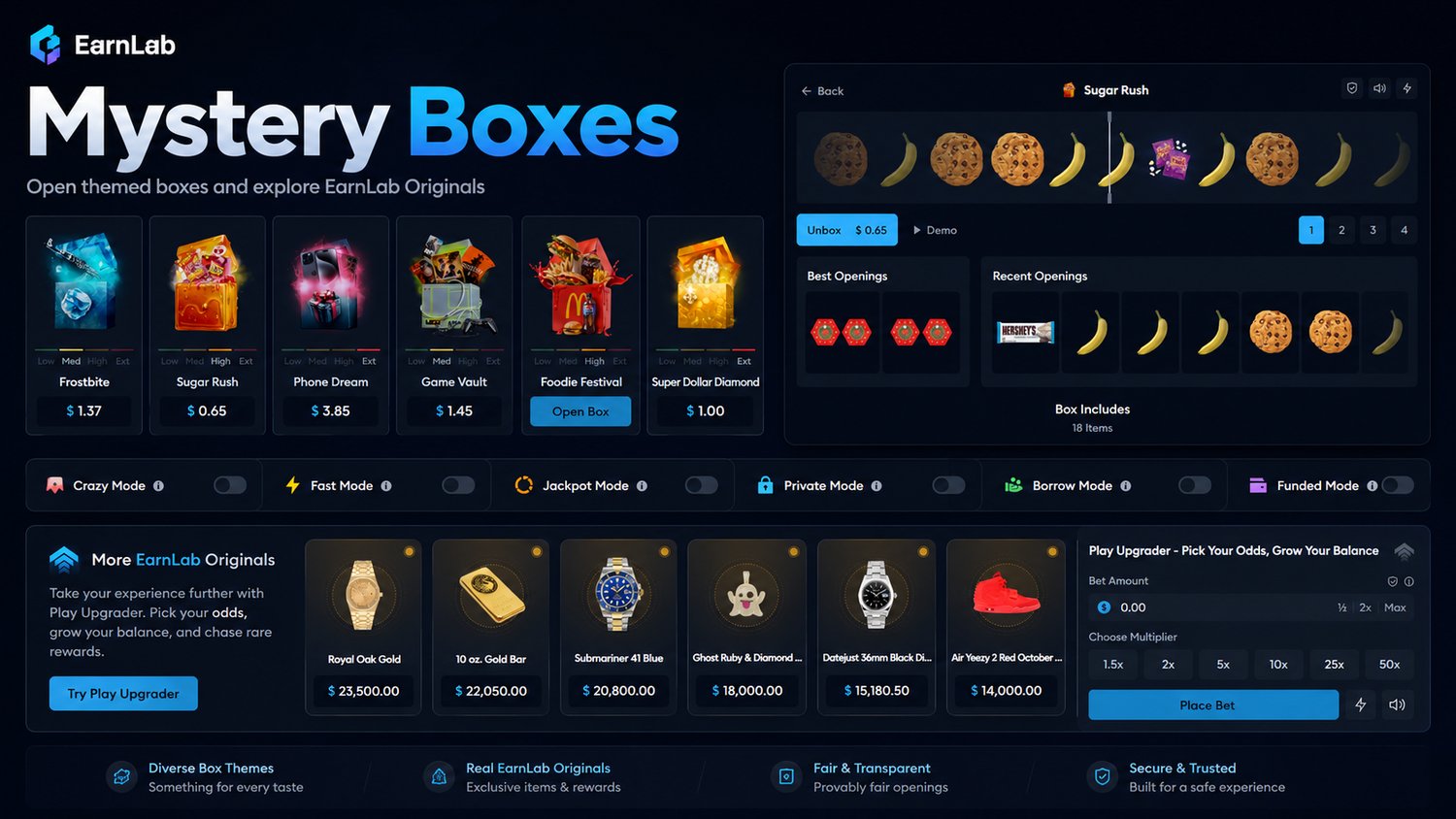
EarnLab positions Boxes as the main entry point into its internal games layer. The terms describe “Cases” as digital loot boxes opened with Credits; the public gaming/box pages market them as provably fair, available in solo or PvP/Battles formats, and even advertise 3 free mystery boxes for new users on some public campaign pages. EarnLab’s mystery-box explainer further stresses that outcomes are recorded using a verification hash that users can check after the opening.
What is strong in public evidence is fairness architecture; what remains weak is live box math. The reviewed sources did not expose current public per-box drop rates, full prize ladders, or box-by-box expected value. That means a rigorous EV analysis must be done inside the live box interface, not from static public pages. EarnLab itself argues that Boxes are financially different from deposit-first mystery box sites because users can earn the points first through tasks and then spend those points on boxes, which changes the user’s effective risk profile. That is directionally true for users who are opening boxes only with earned balance. It is much less true once a user begins purchasing Credits directly.
A rigorous strategy for Boxes is therefore:
- Open boxes with earned points, not fresh deposits, whenever possible. This is the highest-confidence edge EarnLab offers relative to deposit-first case sites.
- Verify fairness each time if you care about auditability. EarnLab explicitly says each opening creates a pre-commitment hash.
- Inspect live odds in the in-app box view before opening. Public sources emphasize the importance of visible odds on legitimate mystery-box sites, but those live odds were not publicly surfaced in the reviewed pages.
- Do not treat Boxes as a primary earnings engine. Treat them as optional upside on top of offer earnings. That is consistent with EarnLab’s own “earn first, then play” framing in its guide.
One additional wrinkle is cashback / rakeback. EarnLab’s mystery-box landing pages advertise “cashback on every play,” while the Terms define rakeback as a return of a portion of Credits used in Games, payable on various schedules at EarnLab’s discretion. The exact percentage is not published in the reviewed public sources, so users should treat cashback as a bonus, not a predictable fixed rebate.
Mines
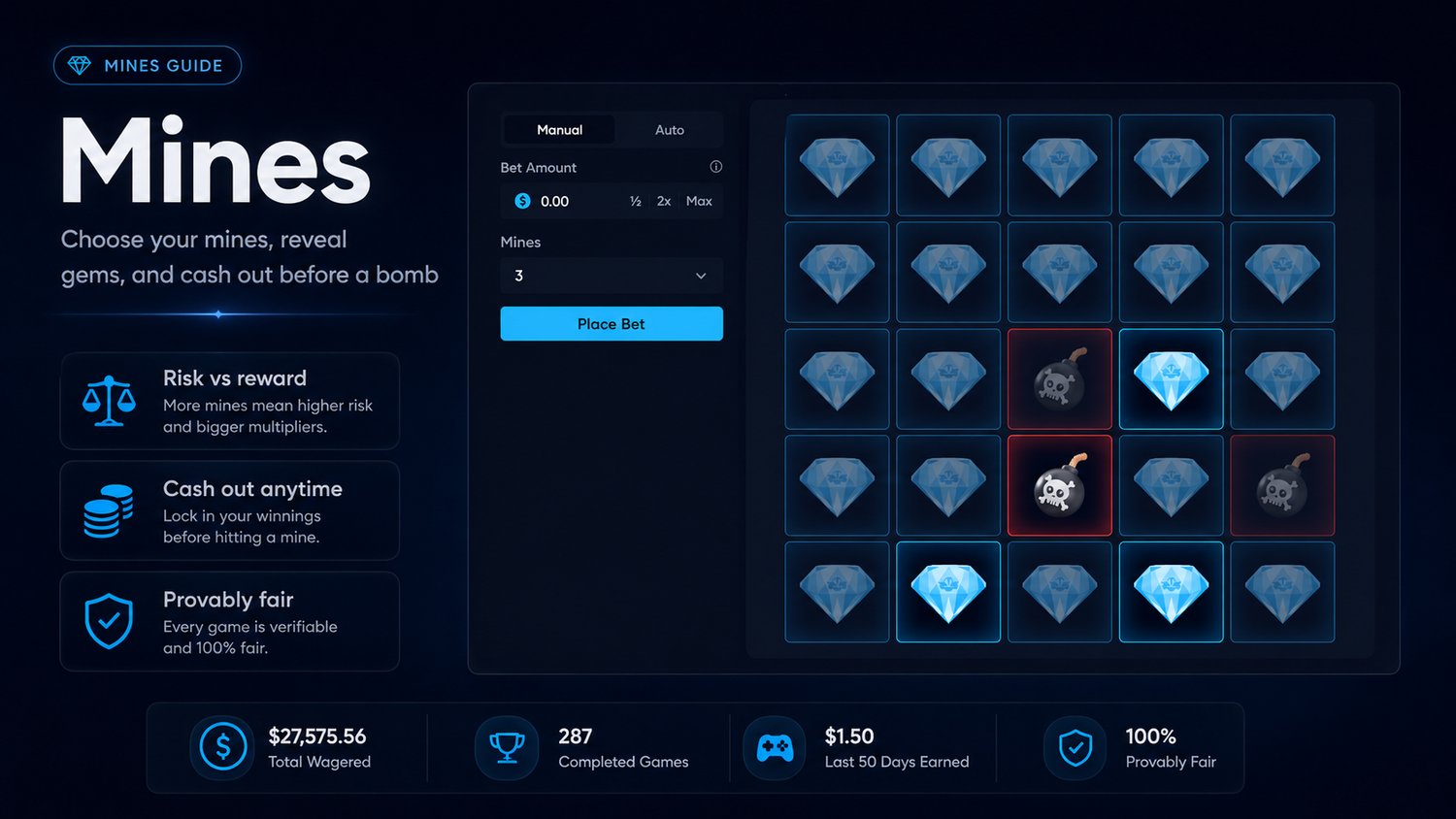
Mines is the best-specified original game in public EarnLab materials. EarnLab says it is played on a 5×5 grid, the player chooses 1 to 24 mines, any safe tile can be cashed out immediately, and the game runs at 98% RTP with a 2% house edge. The page also says there are no bonus rounds, but there is autoplay and loss/profit stop logic.
The cleanest risk math is the survival probability of cashing out after s safe reveals with m mines on a 25-tile board:
That formula follows directly from EarnLab’s published grid size and mine-count rules.
To make the risk concrete:
| Mines chosen | Safe clicks before cash-out | Survival probability |
|---|---|---|
| 1 | 1 | 96.0% |
| 3 | 3 | 66.96% |
| 5 | 2 | 63.33% |
| 10 | 3 | 19.78% |
| 15 | 2 | 15.0% |
These are mathematical implications of the published 5×5 / 1–24-mine rules, not quoted in-game multipliers.
That probability table explains why the most robust Mines strategy is variance control, not pattern-finding. EarnLab itself says there is no guaranteed strategy, because tile placement is RNG-driven and independent from round to round. The most defensible operational rule is to choose a mine count that matches your risk tolerance, pre-commit to a cash-out target or click count, and avoid trying to “win it back” after a loss. The blog’s own practical advice is to start with fewer mines, set a loss budget, and cash out more often than your impulses want.
One caution for rigorous readers: EarnLab’s public Mines materials are not internally perfect as technical specifications. The page advertises a “maximum multiplier up to 5,096,294x,” which is difficult to reconcile with a simple 25-tile combinatorial model, and one public blog example for 3 mines appears more generous than a constant-RTP combinatorial schedule would imply. That does not prove the game is unfair; it does mean the public marketing pages are not a complete mathematical paytable. The safe user conclusion is to trust the live in-game payout ladder, not a headline multiplier on a landing page.
Keno
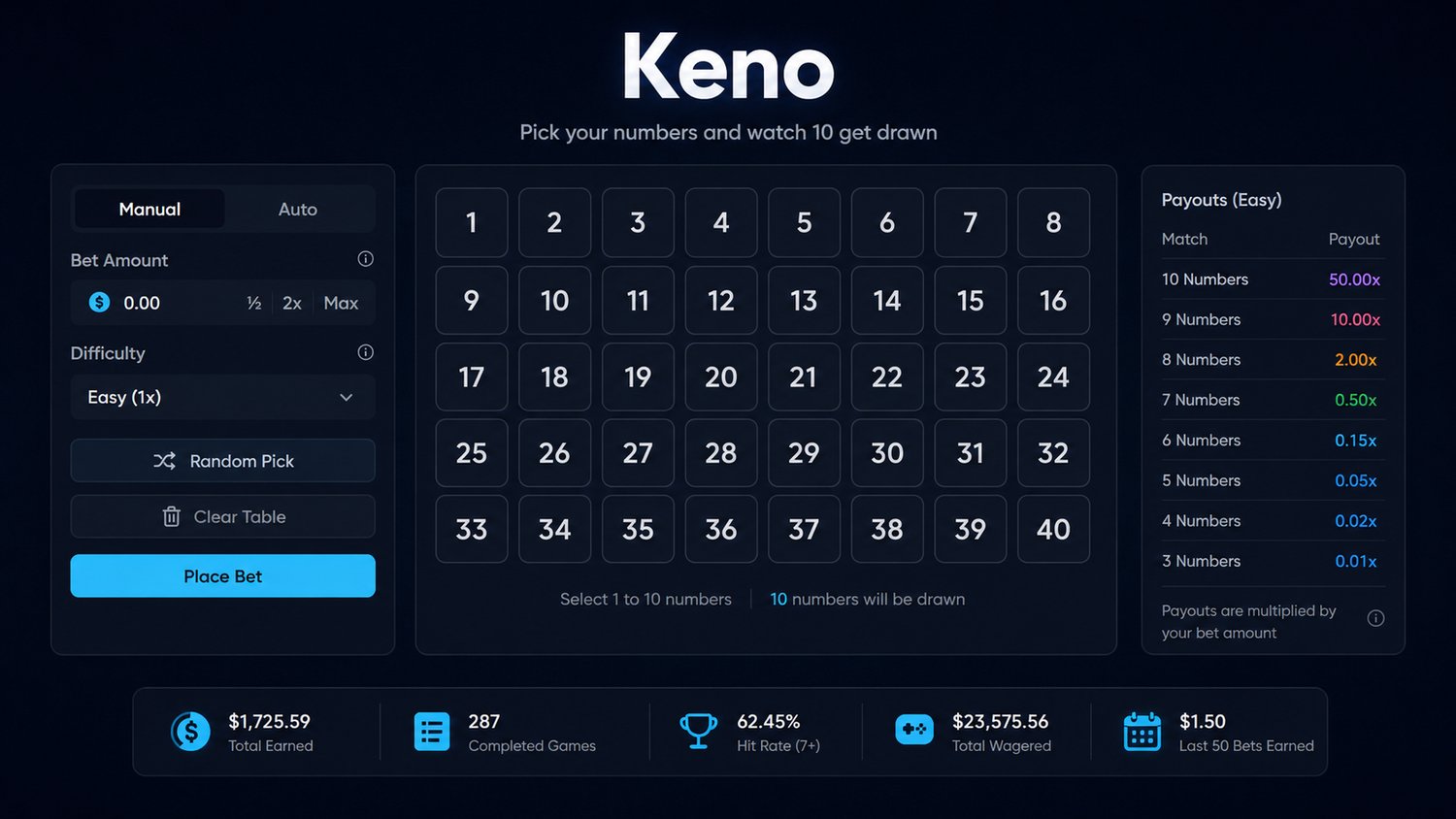
EarnLab’s Keno page and Keno guide are clear on game structure: choose 1–10 numbers from 1–40, then watch 10 numbers get drawn. The page also shows Easy / Medium / Hard difficulty choices, which strongly suggests volatility/payout-table variation, and the guide repeatedly tells users to check the live paytable before playing because payouts vary by game and platform.
The exact probability of matching exactly k numbers when you choose n spots is:
That is standard hypergeometric math applied to EarnLab’s published 40-number pool and 10-ball draw.
EarnLab’s Keno guide includes a sample payout table for a 6-spot $1 ticket:
| Matches | Sample payout on $1 bet | Published sample odds |
|---|---|---|
| 6 | $1,500 | 1 in 7,752 |
| 5 | $75 | 1 in 323 |
| 4 | $5 | 1 in 35 |
| 3 | $1 | 1 in 7.7 |
EarnLab presents this as an example, not as the live universal paytable for the current game.
That distinction matters. If those were the entire paytable, the expected return of the sample 6-spot ticket would be only about $0.70 per $1 wagered. That is not a statement about EarnLab’s current live Keno RTP; it is a demonstration of why EarnLab is right to tell users to inspect the current on-screen table before betting. Because the reviewed public sources did not expose the live Easy/Medium/Hard paytables, the only rigorous “optimal play” advice is:
- Max EV play is whichever live spot-count/difficulty combination yields the highest displayed RTP or strongest expected return after applying the published probabilities.
- Lowest-volatility play is generally the smallest, simplest ticketing structure with lower jackpot dependence—practically, fewer spots and easier tables—because Keno’s variance explodes as more of the return is concentrated into rare big hits.
- No pattern system beats the RNG. EarnLab explicitly says Keno is a game of pure chance and that every draw is independent.
In plain English: if you want Keno as a side game, it is fine; if you want a dependable earnings engine, it is inferior to strong offers and lower-variance cash-out discipline.
Races
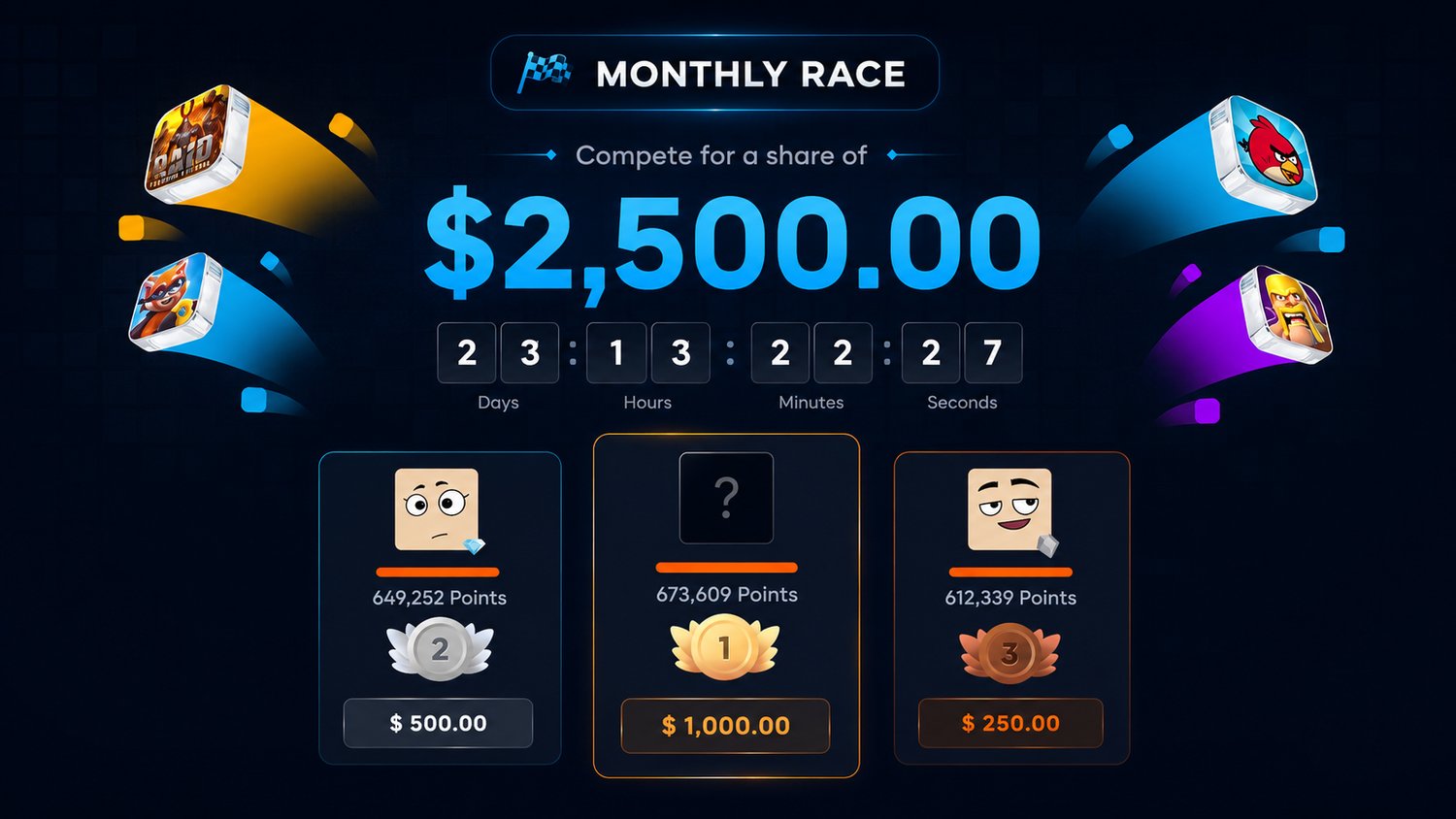
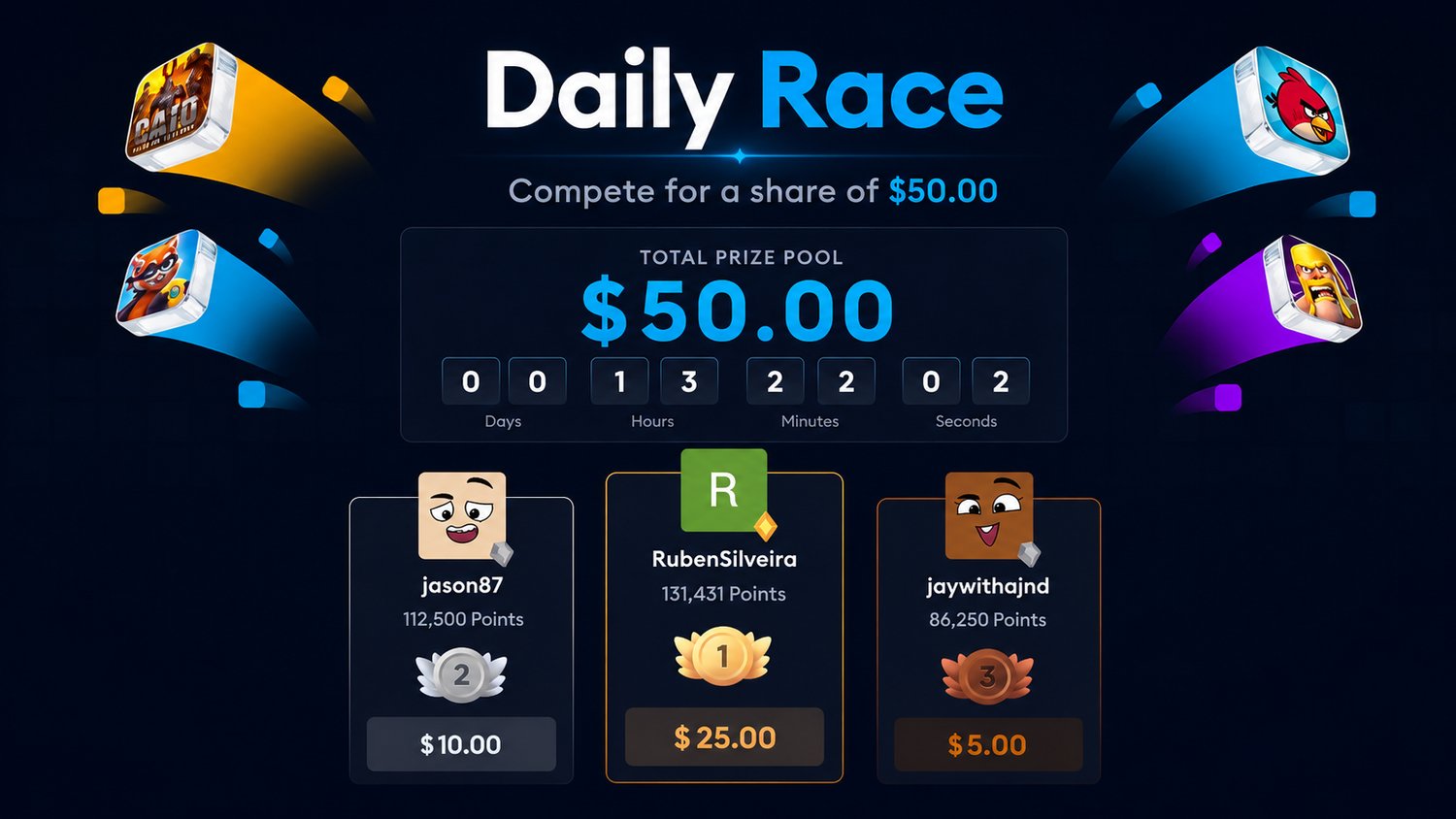
Races are an important extra-yield layer because they reward activity you may already be doing. EarnLab’s help center says participation is automatic, the daily leaderboard resets every 24 hours, the monthly leaderboard resets at month-end, and rewards are credited directly to your balance after reset. It also distinguishes two leaderboard types: an Earn leaderboard driven by completing offers and a Games leaderboard driven by opening boxes, where “the more you wager, the higher your position.” The help center also says ties are broken by who reached the score first.
There is some public inconsistency around monthly prize-pool labeling. An EarnLab guide mentions a $1,500 Monthly Earnings Leaderboard and a separate $2,500 Monthly Games Leaderboard, while current race pages viewed during this research showed a $50 Daily Race and a $2,500 Monthly Race page. The safest operational interpretation is that EarnLab’s leaderboard catalog is dynamic and that users should treat the live race page as the source of truth for current reward distribution.
A current observed distribution from live race pages looked like this:
| Current observed race | Places shown publicly | Current observed payout pattern |
|---|---|---|
| Daily Race | Top 10 | 1st $25, 2nd $10, 3rd $5, 4th $3.75, 5th $2.50, 6th $1.50, 7th $1.00, 8th $0.62, 9th $0.37, 10th $0.25 |
| Monthly Race | Top 50 | 1st $1,000, 2nd $500, 3rd $250, then tapering through top 50 down to $0.50 |
These are current-page observations, not a guarantee that future race pools will be identical.
Race strategy is therefore straightforward. On the Earn side, push higher-value offers when you are already near a payout tier near the end of the day or month. On the Games side, only chase race positions if you were already going to open boxes, because the help center makes clear that Games leaderboard rank tracks wager volume, not net profitability. A race prize can improve your session economics, but it does not eliminate game variance.
Wallets, rewards, and withdrawals
The dual-wallet system
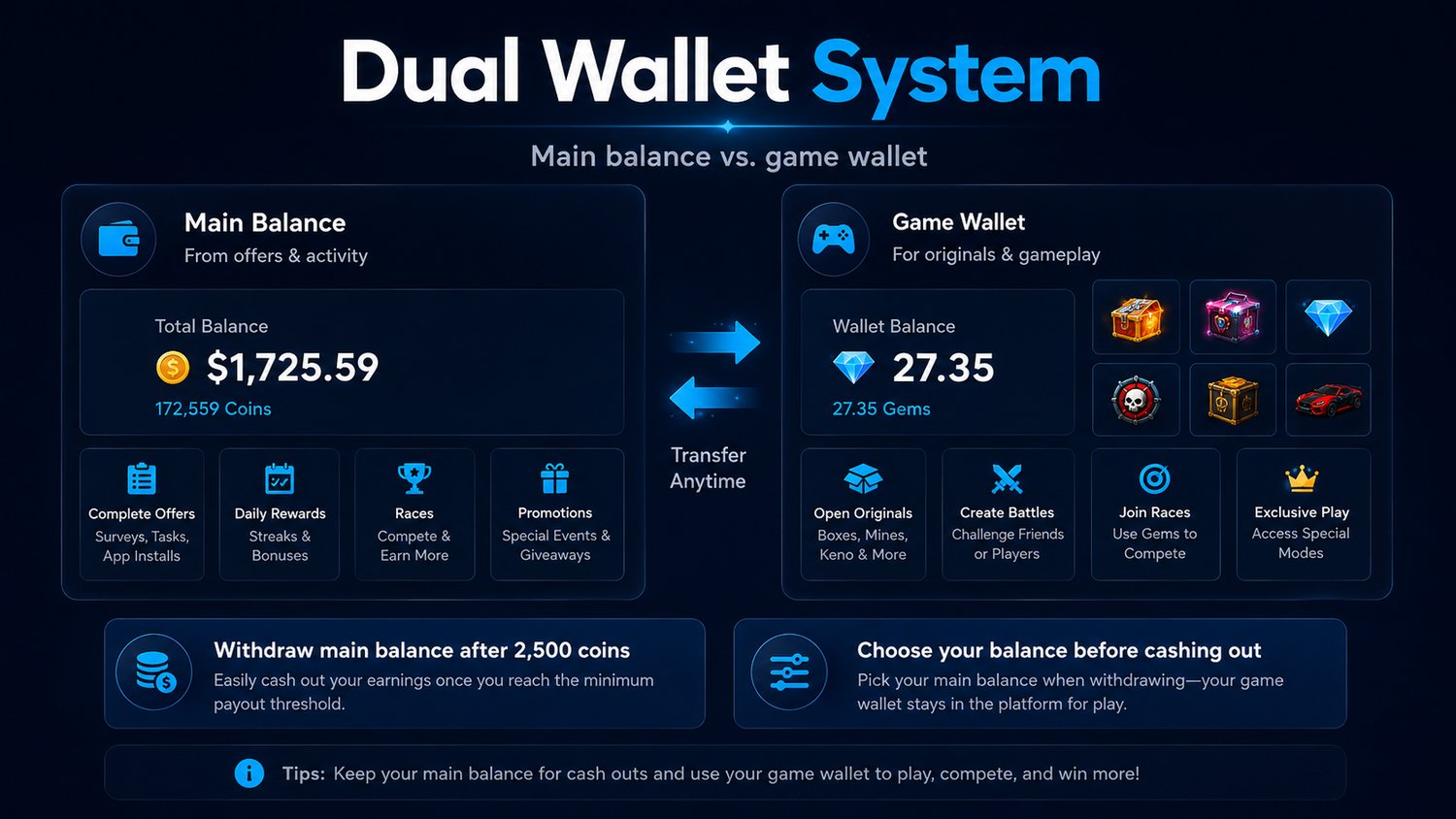
The public user-facing model is a Main Balance plus a Game Wallet. EarnLab says the Main Balance holds task earnings from offers, surveys, and similar activities, while the Game Wallet is used for the games section. The Terms frame the same concept in legal language by saying users earn Coins, may convert Coins into Credits used exclusively in games, and may also purchase Credits directly. The simplest practical reading is that the Game Wallet is the user-facing expression of the game-side Credits economy.
Offers, surveys, and tasks build the Main Balance.
Eligible rewards move through the rewards or cash-out flow.
Coins/Credits can be used in the Game Wallet for originals.
Boxes, Battles, Keno, and Mines live on the games side.
Game-wallet withdrawal eligibility depends on main-balance history or deposit/wager rules.
This flow is a synthesis of EarnLab’s homepage FAQ, its public guide, and the Terms.
A practical wallet comparison looks like this:
| Wallet / balance | Primary purpose | How it is funded | What it is used for | Main public caveat |
|---|---|---|---|---|
| Main Balance | Holds offer/survey/task earnings | Earning via offerwalls, surveys, tasks | Direct redemption/withdrawal path | Public sources suggest a 2,500-Coin earned threshold before normal main-balance withdrawal access |
| Game Wallet / Credits | Dedicated games-side balance | Converted earnings and/or direct Credit purchase | Boxes, Battles, Keno, Mines | Withdrawal unlock appears gated by either main-balance earnings history or a fully wagered $5 deposit |
This framing is the most consistent way to reconcile the homepage FAQ with the Terms and help-center withdrawal rules.
Rewards catalog and redemption options
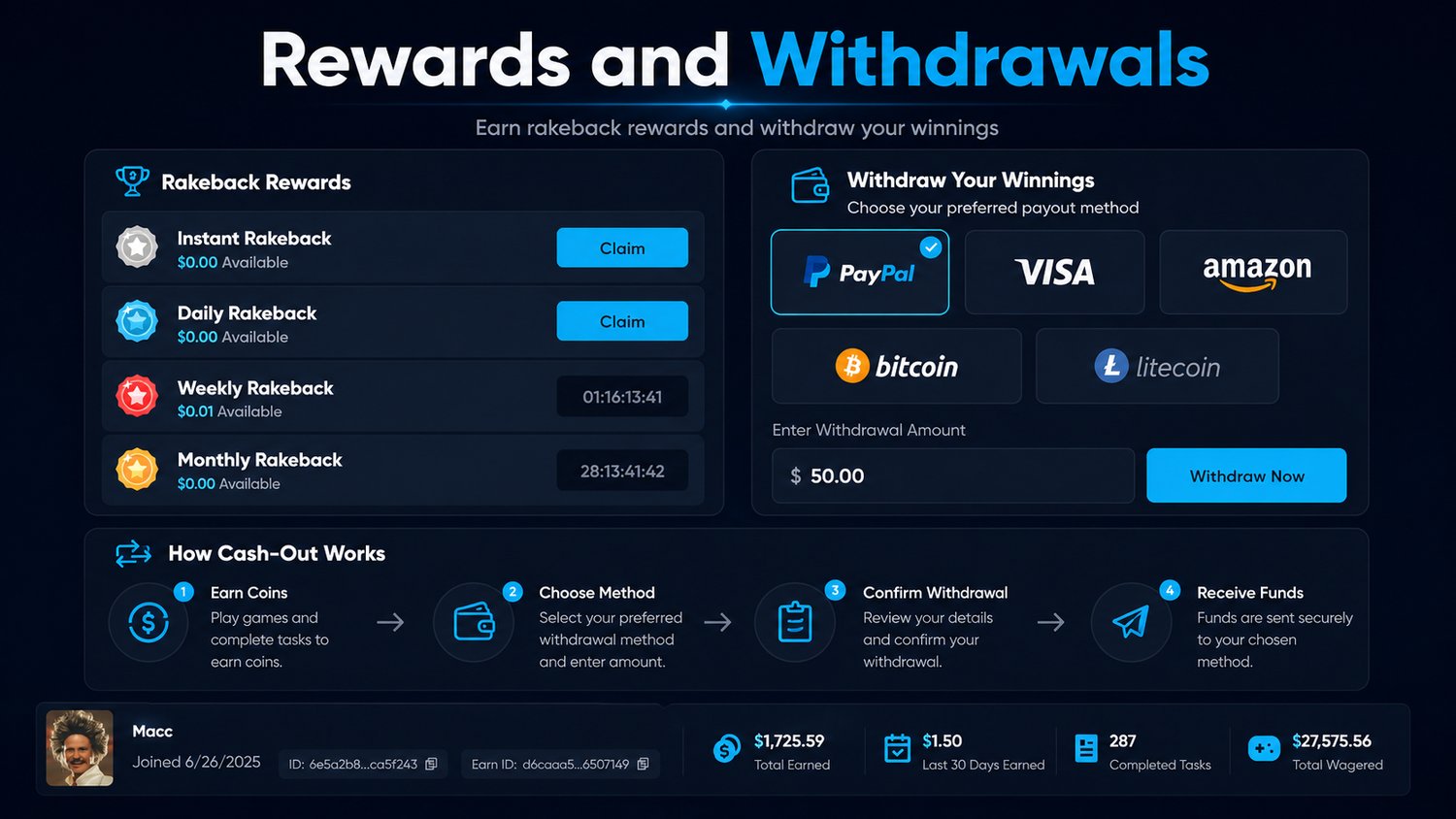
Beyond base cashout methods, EarnLab’s public Rewards page advertises a VIP program with tiers such as Silver, Gold, Diamond, and Obsidian, and benefits including promotional bonuses, weekly bonuses, monthly bonuses, random completion bonuses, and task boosts. The same page also advertises 7-day streak boxes and a 50-mission progression with milestone rewards. Public examples on that page show mission requirements tied to specific offerwalls and milestones such as earning certain amounts on Torox, TyrAds, and Adscend Media, or hitting withdrawal thresholds.
The main public redemption catalog includes PayPal, gift cards, and crypto in multiple places. Additional official sources expand that list to bank transfer in supported regions, cash methods including Visa and Cash App examples, Gamdom, and region-filtered gift cards such as Amazon and Steam plus dozens more. Crypto choices confirmed in the help center include Bitcoin, Ethereum, Litecoin, Solana, USDT, USDC, Tron, XRP, and Chainlink.
One subtle but important point: EarnLab says offer earnings are shown in USD, but withdrawal requests are converted into your local currency for region-based cash/gift-card redemption, while crypto withdrawals are converted into the selected coin at processing time. That means the timing of withdrawal can slightly change your net outcome due to FX or crypto pricing.
Withdrawals, limits, fees, KYC, and timing
EarnLab’s withdrawal rules are partly split across multiple pages, so the most rigorous reading is consolidated below:
| Item | Current best-supported public answer |
|---|---|
| Platform withdrawal fee | EarnLab says it does not charge withdrawal fees |
| Cash-method fees | Third-party processing fees may appear and are shown in the modal |
| Crypto fees | Network fees are deducted from the withdrawal amount |
| Method minimums | Cash $5, crypto $0.25, Gamdom $0.25, gift cards vary |
| Overall limits | No maximum withdrawal cap; larger/multiple withdrawals may be reviewed |
| KYC / ID | No routine ID verification required before withdrawal, but quick face scan is required at claim, and Terms reserve the right to request proof-of-age/ID |
| Processing time | Most withdrawals are ready within about 1 hour; manual reviews can take longer, often 24–48 hours for flagged cases |
| Currency | Offers display in USD; withdrawals convert to local currency or selected crypto |
This is the most up-to-date interpretation of the help center.
Two important nuances deserve explicit mention. First, a public EarnLab guide states that the Main Balance minimum to withdraw is 2,500 Coins = $2.50, and that LTC or Solana can be practical starting methods, while PayPal may be less efficient, but the newer help center now says cash minimum is $5 and crypto minimum is $0.25, with no EarnLab fee. The help center is more recent and should be treated as authoritative where the two differ. Second, the Terms say rewards must be redeemed within 90 days of the reward date, after which EarnLab may revoke them.
In user terms, the optimal withdrawal workflow is: use low-friction crypto if you are comfortable with it and network choice matters to you; if you prefer cash, expect a higher minimum and possible provider fees; avoid spamming many small withdrawals in rapid succession; and remember that a “first withdrawal” or unusual account pattern may still trigger review even though most normal withdrawals are automatic.
Security, fraud controls, and legal considerations
Security, fraud prevention, and user protections
EarnLab’s public security model has multiple layers. The withdrawal side includes automated checks, manual review for large or clustered withdrawals, and a one-time face scan at claim. If an account is flagged during withdrawal, EarnLab says the payout is paused, reviewed manually, and typically resolved within 24 to 48 hours, though longer reviews can happen in more complex cases.
On the data-security side, EarnLab’s Privacy Policy says it uses secure servers, firewalls, encryption, data-center physical access controls, and backup systems. It also says it has procedures for handling suspected data breaches and will notify users and authorities where required. The same policy says certain personal data may be retained for at least five years after account closure where legally required, and may be kept longer for fraud prevention, compliance, and legal defense purposes.
User protections and obligations can be summarized as follows:
| Control area | What EarnLab says publicly | Practical user implication |
|---|---|---|
| Withdrawal security | Face scan at claim; reviews for large/unusual withdrawals | Keep account details accurate and expect reviews on unusual patterns |
| Account/offer fraud | VPNs, multiple accounts, duplicate offers, and suspicious earning patterns can trigger flags or bans | Stay within one account, one identity, one legitimate completion path |
| Data security | Secure servers, firewalls, encryption, backups | Reasonable safeguards exist, but no platform claims perfect security |
| Data rights | Access, rectification, erasure, restriction, portability, complaint rights | You can invoke privacy rights through support |
| Offer disputes | Wait 72 hours, then use provider history/support or EarnLab’s task support path | Screenshot evidence is part of your protection toolkit |
These points are drawn directly from the help center, privacy policy, and Terms.
Legal and regulatory considerations
EarnLab’s Terms require users to be of the approved legal age in their jurisdiction and explicitly state that it is the user’s responsibility to check whether activity on the site is legal in their country of access or residence. The Terms also say that taxes on earnings are the user’s responsibility, not EarnLab’s. That is the most important compliance takeaway for users in any gray-area jurisdiction.
For games and wallet mechanics, the legal language is careful. EarnLab’s Terms say Coins and Credits have no real-world value and cannot themselves be withdrawn or exchanged, while Rewards may be received through gift cards, PayPal credit, crypto, or other methods. At the same time, public user-facing pages describe the experience as “withdrawals” and “cash out.” The practical interpretation is that EarnLab is legally distinguishing between internal units and redeemable rewards. Users should understand that “withdrawing” on the front end is, in the Terms, closer to redeeming rewards generated from platform activity than withdrawing a stored cash balance.
That distinction matters most in the games section. Because Games includes chance-based formats like Boxes, Keno, and Mines, and because the Terms allow direct purchase of Credits, the precise regulatory treatment could vary by jurisdiction. This report does not classify EarnLab legally; it simply notes that EarnLab itself tells users to verify local legality, and that users in stricter jurisdictions should read the Terms, Privacy Policy, and any jurisdiction-specific rules carefully before depositing or converting value into game Credits.
Practical playbook and FAQ
A user who wants both offers and original games should follow a hybrid strategy like this:
- Build a main-balance cushion first using high-value offers, especially mobile game milestones, strong sign-up/cashback tasks, and only the best survey opportunities. EarnLab’s own guide points users toward higher-value offers and says to compare walls before committing.
- Use surveys as filler, not the core plan, unless your demographic happens to qualify unusually well. EarnLab itself says screen-outs of 50%+ are common.
- Withdraw a baseline amount before moving serious value into Games. That is the cleanest way to keep the games layer from diluting your effective hourly earnings. EarnLab’s guide explicitly recommends treating games as a separate budget.
- If you play Boxes, do it with earned points first and verify the fairness hash when it matters. Since public drop tables are not fully available, assume the edge is on the house unless the live in-app odds prove otherwise.
- If you play Mines, choose low-to-mid mine counts and pre-commit a stop rule. The game is genuinely interactive, but the only sustainable edge is bankroll discipline, not prediction.
- If you play Keno, inspect the live paytable every session and keep stakes small. Difficulty appears to alter the paytable, and the public sample table is only illustrative.
- Use races opportunistically. If you are already close to a prize tier, a final push can be rational; if you are far away, chasing a leaderboard with low-EV actions usually is not.
Common pitfalls are predictable:
| Pitfall | Why it hurts | Better move |
|---|---|---|
| Starting an offer without comparing walls | You may leave $5–$15 of value on the table on large tasks | Compare 2–3 walls first |
| Using a VPN or privacy-heavy browser setup | Breaks tracking and can trigger sanctions | Use a clean, supported browser with cookies/JS enabled |
| Repeating the same offer on another wall | Can trigger chargebacks and account flags | Complete each campaign once unless explicitly marked repeatable |
| Treating surveys as reliable hourly income | High disqualification rates waste time | Use them selectively as filler |
| Depositing into Games before understanding withdrawal unlocks | Creates avoidable wallet friction | Read the main-balance vs game-wallet rules first |
| Chasing losses in Mines/Keno/Boxes | Variance compounds quickly | Set hard session limits before you start |
These pitfalls and fixes are directly grounded in EarnLab’s guide and help-center rules.
FAQ
Is EarnLab better used as a task platform or as a game platform?
For most users, it is better first as a task platform and second as a games platform. The offers side is where predictable earnings come from; the games side is where optional variance and entertainment upside live.
What is the single biggest earnings mistake on EarnLab?
Failing to compare the same offer across multiple offerwalls before starting it. EarnLab’s own guide says this can cost $5–$15 on high-value tasks.
Are surveys worth doing?
Yes, but selectively. They are best used as short filler work, especially when you qualify well. They are not the most reliable high-hourly-rate path because screen-outs of 50%+ are common.
What is the safest original game for a disciplined user?
Among the publicly documented games, Mines is the easiest to control behaviorally because you can define your own cash-out and loss rules. That does not make it +EV; it makes it more controllable than a blind mystery-box open.
What is the biggest unknown in the public materials?
The full live box drop tables and the full current Keno paytables by difficulty are not exposed in the public sources reviewed, so exact game EV analysis cannot be completed from public pages alone.
Should I worry about KYC?
Routine ID verification is not presented as mandatory before withdrawal, but EarnLab does require a face scan at claim, and the Terms reserve the right to request proof-of-age or identity documents where needed.
Open questions and limitations
Several public items remain incomplete or internally inconsistent. The most important are the live box drop rates, the current full Keno paytables by difficulty, the exact VIP thresholds, the partially inaccessible public AML/KYC page, and some public inconsistencies around Mines multiplier marketing and monthly leaderboard pool labels. For those items, this report has used the most conservative reading: trust the help center over older blog copy, trust the live in-product paytable over landing-page marketing numbers, and treat any non-published value as unspecified rather than guessed.